How To Make More Impact
You are saying YES when you mean NO
You know that feeling when your phone buzzes and it's a WhatsApp message from a colleague:
"Can you quickly review this?"
No context and no deadline, and no explanation of what they actually need.
And within about three seconds, you have typed back: "sure, send it over."
You didn't think about it. You just said yes.
By Friday, you're running on empty and you're not entirely sure why.
Most professionals don't burn out from working too hard. They burn out from carrying responsibilities that were never theirs to begin with.
Here's what's actually going on and what to do about it.
Why good intentions don't survive Monday
Think about Vanessa. She works as an assistant at a physiotherapy centre. A client calls in a panic: they need an emergency appointment. Vanessa says yes, squeezes them in, and the whole day's schedule falls apart.
She spends the rest of the week fixing it. She tells herself she just needs to be better organised. She works harder. And the following week, the same thing happens.
You take a holiday, come back with good intentions, and by Tuesday you're back exactly where you started. Not because you lack willpower, because you've returned to an environment that keeps rewarding the same behaviour. Nothing in it has changed.
The first step isn't forcing new habits overnight. It's noticing the pattern. Once you can see that you're saying yes automatically, you have a choice. Before that, you don't.
The ownership gap
If you treat exhaustion as a workload problem, you will keep reaching for workload solutions, better time management, stricter priorities. And you'll stay exhausted.
The real issue is simpler: you're carrying things that aren't yours to carry.
It often happens quietly. A colleague brings you a problem. Instead of asking what they've tried, you solve it.
A meeting ends awkwardly. Because you hate loose ends, you pick up the action point. Nobody asked you to. You just did.
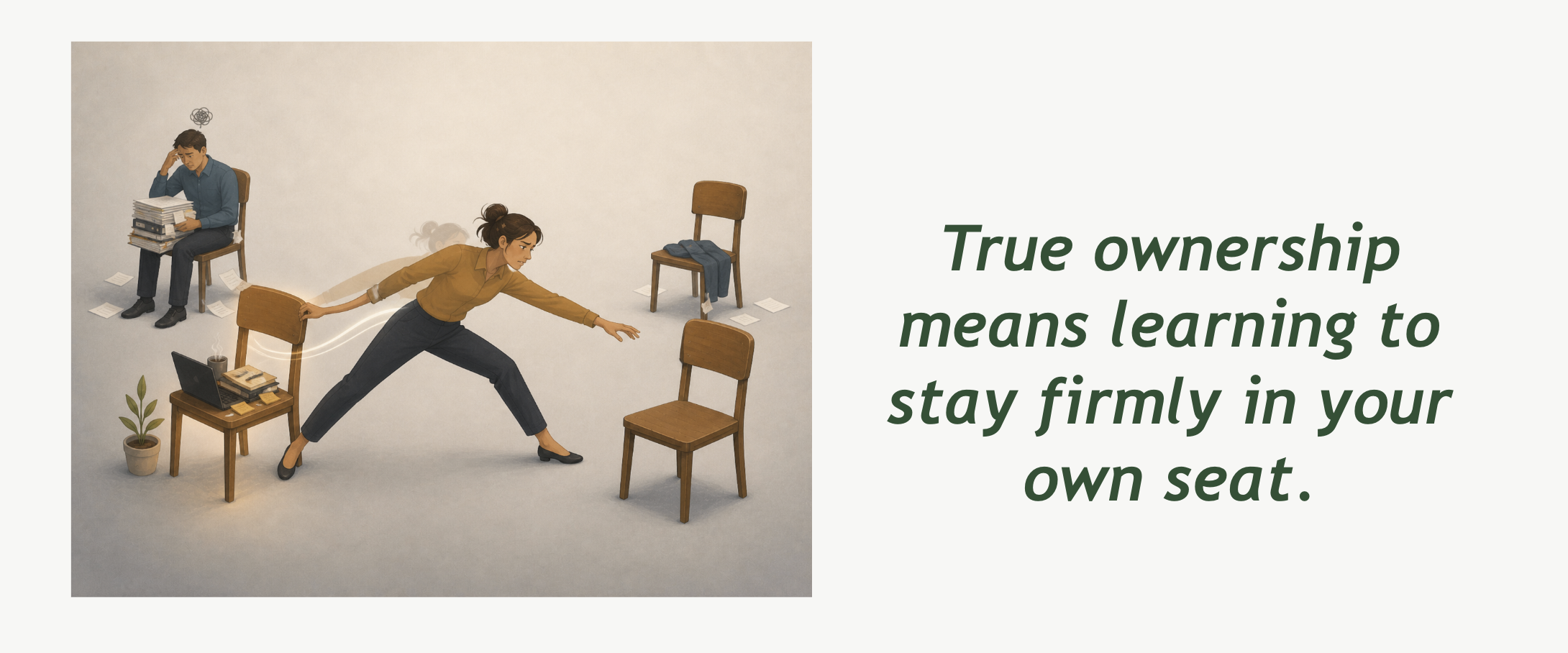
Think of your role as a chair. Every time you step off your own chair to solve someone else's problem, that's where your energy goes. Three questions that help:
"Whose chair am I actually sitting on right now?"
"What have you tried so far?"
"Just to confirm, who owns this next step?"
The Freeze
Knowing this isn't enough on a tense Tuesday afternoon. Your boss rushes in ten minutes before you're supposed to log off: "Can you quickly review this?" Logic goes offline. Your body takes over. And your deeply trained response, keep the peace, say yes, kicks in before you've even thought about it.
This is the freeze response. It's not a character flaw. Most of us have been running this pattern since childhood, we learned early that saying yes keeps things smooth.
What helps: notice the physical sensation first. Then breathe. Breathing brings your thinking brain back online and creates a few seconds of space between the request and your answer. That space is where your choice lives.
You don't have to say no at that moment. You just have to not say yes automatically.
This isn't just an individual problem
We ran a live coaching session during the masterclass with a manager leading a new team of eight. Her description: "It is chaos. Everyone is doing a bit of everything." People weren't saying no out of fear. The same patterns that drain you individually play out at team level too. The chair principle, the freeze response, the ownership gap, they shape how entire teams function.
Knowing isn't doing
Knowing isn't doing. You probably already knew you needed to set better boundaries. But knowing and doing are two different things. Changing a pattern you've been running for years takes practice, in a safe environment, with people who can support you.
Here's the thing about summer: it's the one window you actually have. Once September hits, it's KPIs, performance reviews, and back-to-back everything. If the pattern doesn't shift now, it won't shift until next year.
The Summer Academy 2026 is a 2-day personal leadership intensive in Leusden (August 27–28),
led by Allard Klok and Simon Jansen. Very practical, small group, personal attention. Early bird price is €925, but that closes June 1st.
Book a free 15-minute Discovery Call to talk through your situation and see if it's the right fit.