He quit his job with no plan. Then he traveled alone for a year.
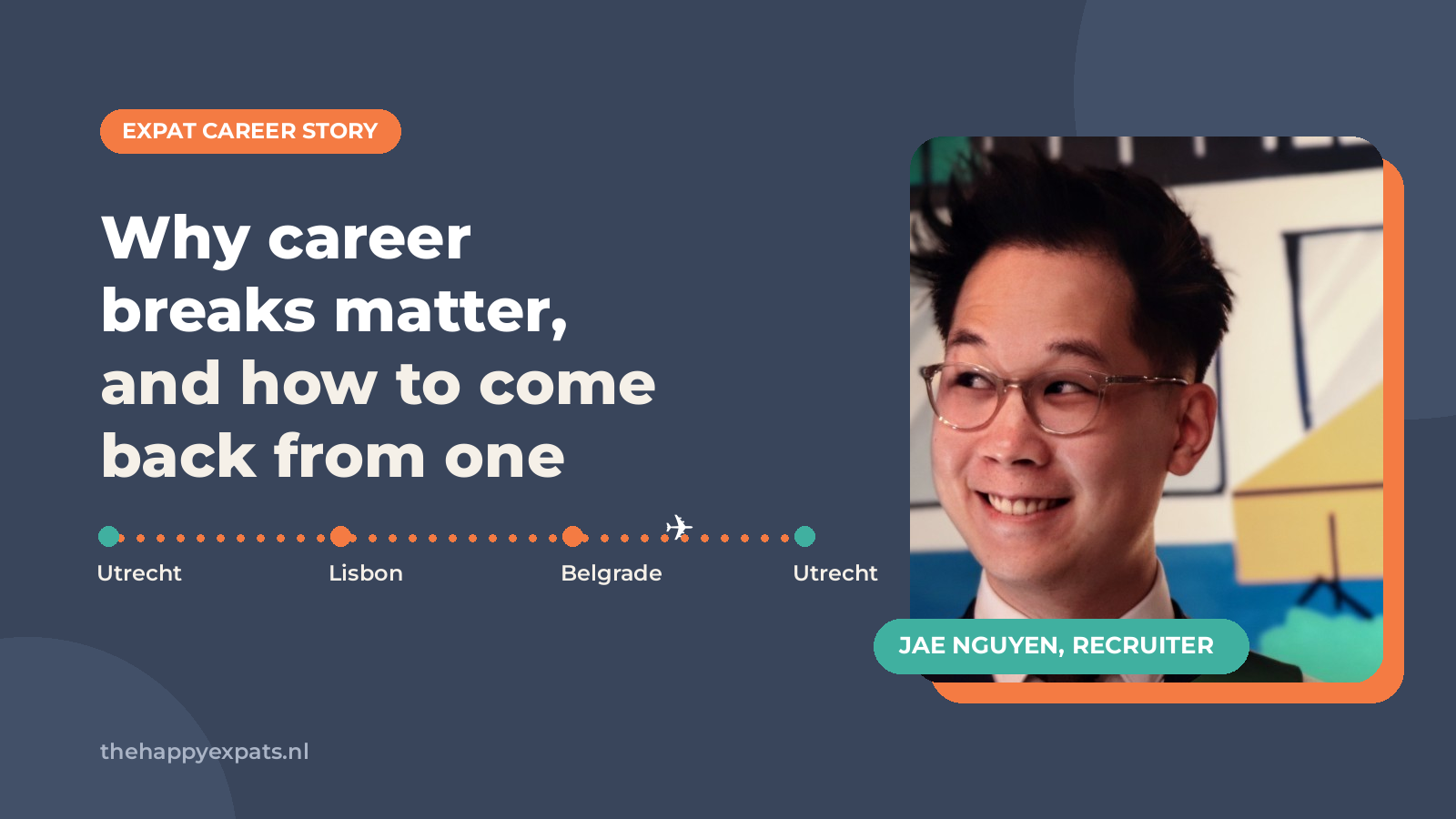
A career break isn't a gap in your story. For recruiter Jae Nguyen, it was the chapter that made the rest make sense. Here's what he learned, and how he's coming back.
Many internationals in the Netherlands worry that time off will look bad on their CV. So they stay in jobs that no longer fit, because stopping feels riskier than staying.
Jae Nguyen took that risk anyway. He has been a recruiter for close to a decade. He's placed people in roles they love. He's sent those Friday afternoon messages: "Hey, that job you and I were talking about? You got it." And he's felt the kind of satisfaction that, as he puts it, no other job can reproduce.
And then, about a year and a half ago, he quit. With no next step lined up.
This is his story.
Relief, then panic, then: just go
Jae didn't leave recruitment because he fell out of love with it. He left because somewhere along the way, the job stopped feeling like his.
The role he had signed up for and the role he was actually doing had drifted apart. And after months of trying to close that gap, he couldn't keep going.
The moment he handed in his notice, something changed. He also appreciated how kind his employer was once he had made his decision.
And then he was sitting in his Utrecht apartment with no plan and a question he didn't know how to answer: who am I outside of this job?
So he did the only thing that made sense at that moment. He bought a ticket to Portugal. Then Spain. Then he worked his way through almost all of Eastern Europe: Macedonia, Moldova, Bosnia, Serbia. He spent the most time in Belgrade.
The moment in Belgrade that changed something
He arrived in Belgrade during the student protests. Young people were blocking city centres, boycotting universities and sleeping on the streets to demand accountability from a government they felt had failed them.

The National Assembly in Belgrade, photographed by Jae during his stay.
"Being swept up in this type of energy lets you see how small your problems are in comparison. These people are fighting for their lives. And they still have the energy to say: I'll be back later tonight. I'm going to go fight for my country real quick."
It gave him a fresh perspective on his own life. "I realized how little I needed. I don't need expensive watches. I don't need the fancy suit and tie. Just give me a couple of black t-shirts and my jeans. I'm good to go."

Breakfast company on the terrace in Belgrade: Milica, Jae's neighbour, came by every morning to keep him company.
What he came back knowing
Jae has been back in the Netherlands for over two months. He's job searching again, this time as a different version of himself.
He still wants to be in recruitment. He loves it. The ability to connect with someone and make a real difference in what they're trying to build doesn't go away. But the environment matters enormously now.
He's in conversations with companies in mental health and in tech with a genuine social mission: places where the people-first mentality is leading.
He knows the market is slow. AI has changed the role significantly: one recruiter can now do what used to take three or four. He's okay waiting, and he's not going to take something he doesn't believe in just because the market is pressuring him to.
The +10% philosophy, and why "110% every day" is a lie
If you've seen Jae's LinkedIn profile, you've probably noticed his headline includes "+10%". Here's where it comes from.
Years of reading applications taught him something. Almost every candidate writes: I give 110% every day. He heard it in interviews constantly. And at some point, he started thinking: that's not healthy. That's not even possible.
"Where's the remaining energy coming from? Do you have time for your family? What do you mean you give 110 every day?"
The +10% idea came from a book he read in college. The principle: it's okay to be underperforming. It's okay to be at 40%, 60%, 80%. You're a human being with emotions, with ups and downs. But when you're not at your best, try to squeeze out just a little bit more. Ten percent above wherever you are.
"If you're at 10, give 20. If you're at 30, give 40. It'll compound and make a difference."
And sometimes 10% more doesn't mean working harder. Sometimes it means going to bed earlier and being a little kinder to yourself. That counts too.
One thing he wants people to take from his story
Jae doesn't think his experience is unique. He thinks it's actually very common, especially among internationals: people who've built their whole identity around a career in a country that isn't theirs.
What he'd want others to hear, especially people going through something similar:
"You are not your job. You never will be your job. Your job is not going to be there when you're suffering. It will replace you next week if you leave. Treat it accordingly. And figure out who you are outside of work hours, because that person matters more."
How to come back from a career break
Jae's story shows that a break doesn't have to set your career back. Here's what you can take from it.
1. Know why you left. Jae didn't stop loving recruitment. The role had drifted from what he signed up for. That clarity now tells him exactly what to look for.
2. Let the break change your criteria. He isn't chasing any recruitment job. He's talking to purpose-driven companies where people come first.
3. Be patient, not desperate. The market is slow and AI is reshaping his field. He's choosing the right fit over the first offer.
4. Come back at +10%, not 110%. You don't have to prove yourself overnight. Small, steady steps compound.
5. Name the break, don't hide it. Give it one honest line on your CV and add it to your LinkedIn experience section. Told clearly, a break shows self-awareness and what you stand for.
Jae is currently based in Utrecht and open to recruitment roles at purpose-driven companies. You can find him on LinkedIn and connect directly.
Thinking about a career break, or coming back from one? We'd love to help you plan your next step.
Book a free intro call and let's figure out where to start.