What Recruiters Actually See When They Open Your CV
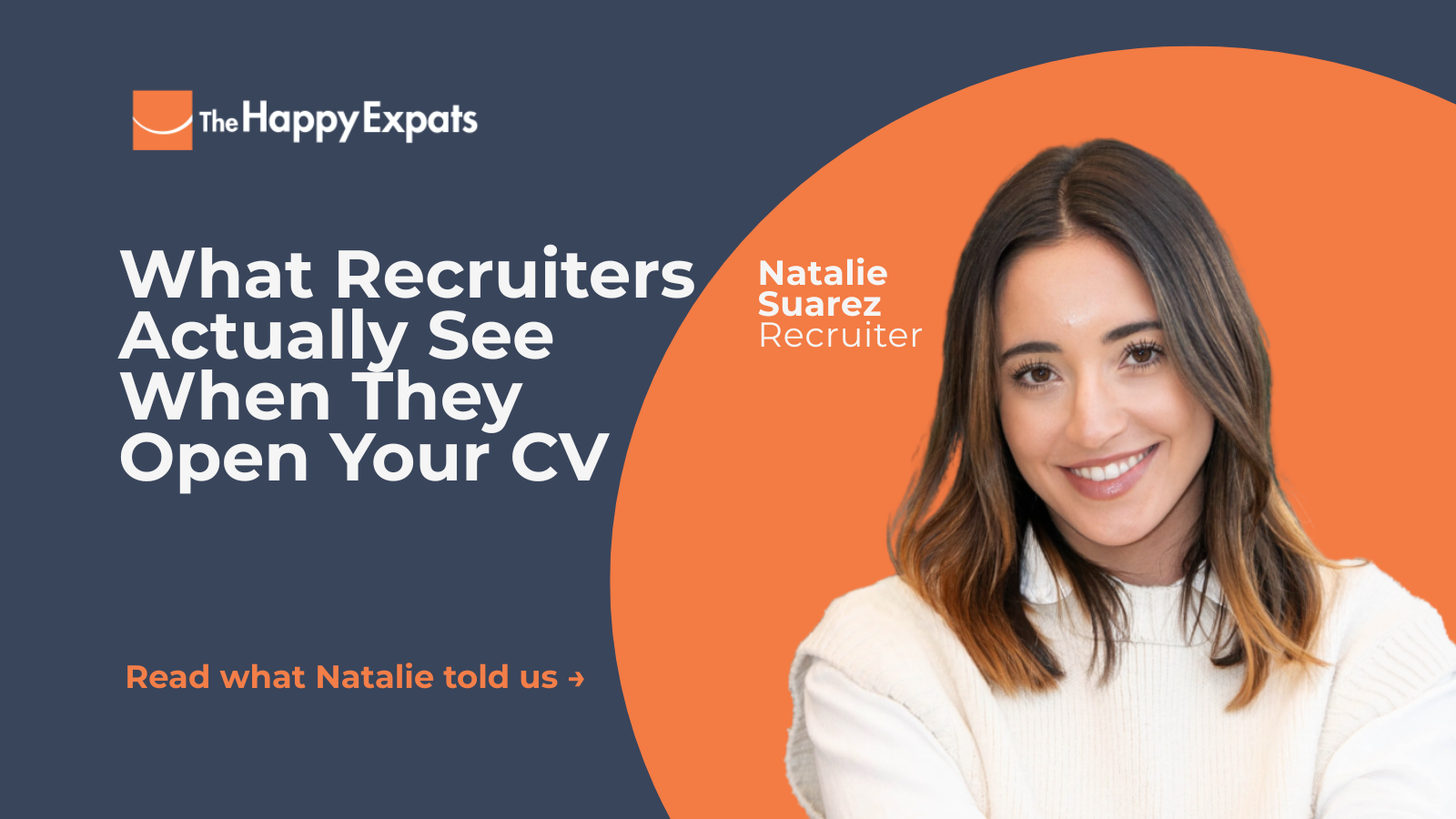
For today’s Happy Expats Community session all 40 spots were booked, and it's easy to see why. We invited Natalie Suarez, a recruiter at Abroad Experience Recruiting Agency, to answer one question honestly: what actually happens to your CV after you hit submit?
Here is what she told us.
The 9-second rule is real
Recruiters see over a hundred CVs a day. Natalie confirmed she spends about 9 seconds on a first look. In those seconds, her eyes go to whatever is bolded, then to your city, your current job title, and your experience timeline. Languages come next.
Your first filter isn't a human
Before a recruiter ever opens your CV, an ATS (applicant tracking system) or AI has often already sorted it. The first cuts often happen on the basics: language and location.
Natalie's advice: always put your city and country on your CV, even if you think it's obvious. Recruiters can't assume where you are located.
Keywords matter just as much. Some systems filter candidates based on how closely your CV matches the job description. You don't need to rewrite your CV for every application, but if you notice the same requirement showing up again and again in your target roles, make sure that word appears on your CV too.
And skip the beautiful Canva template: fancy layouts with columns often don't transfer properly into an ATS. The system can't read what it can't parse. Use a Word document or Google Docs, keep it to one column, and choose a plain, readable font like Calibri or Arial.
Hard skills get you the interview. Soft skills get you the job.
Natalie doesn't recommend listing soft skills like "strong communicator" or "team player" on your CV. Recruiters don't take those claims at face value from a page. They want to see soft skills in the interview.
What belongs on your CV are hard skills: the tools, languages, and platforms you know. HubSpot. Salesforce. Python. PowerBI. These are concrete, checkable, and they're what gets a recruiter to pick up the phone.
Numbers do the heavy lifting
If your experience section reads like a list of responsibilities, it's working too hard for too little return. Compare:
"Responsible for data analysis using Python." versus "Analyzed large data sets in Python, identifying trends that increased efficiency by 15%."
The second version tells a recruiter what you actually did and what changed because of it. Natalie was clear that this is what stands out, and she said something interesting about why: when people scan blocks of text, their eyes go straight to numbers. It makes your impact easy to find, even in a 9-second scan.
If your original numbers don't translate well internationally, she suggested reframing them as percentages, or finding another concrete way to show the result. You don't need a number in every bullet. You do need the reader to understand what happened because you were there.
A few things people forget
Some of the smaller points from the session are easy to miss but make a real difference:
Add your native language, even if it seems obvious. Don't assume a recruiter will guess it.
Keep experience to three or four roles, with three to four bullet points each. More than that, and a recruiter simply won't read it all.
Link a portfolio if you have one. Natalie shared a story of a candidate who was overlooked, sent a portfolio afterward, and got the interview because the hiring manager was impressed.
On visa status: if you don't need sponsorship, say so clearly near the top. If you do need it, it's often better to leave it open and let the conversation happen once a recruiter reaches out.
Career breaks are fine to include. Add them like an experience entry with one sentence explaining the reason. It answers the question before a recruiter has to ask it.
Don't convert your CV to Dutch if your Dutch isn't there yet. Natalie mentioned that recruiters and hiring managers can often tell when an AI-translated CV doesn't match the candidate's actual language level, and it can work against you.
Reach out. It works.
Natalie confirmed that messaging the hiring manager or recruiter directly after applying genuinely helps you stand out in a crowded market. Find the person who posted the role if you can. If not, look for a recruiter or someone on the team you'd be joining. A short, specific message about why you're a fit goes a long way, as long as it doesn't read as generic or desperate.
If you only change three things
We asked Natalie what she'd tell every candidate to fix first. Her answer:
Tailor your CV to the job you're applying for.
Cut it down. Most CVs carry far more text than a recruiter will ever read.
Make sure the basics are impossible to miss: location, languages, and contact details.
If this session sparked a few things you'd like to fix on your own CV, our Boost Your Career group program starts on August 12th. Three Wednesday evenings, working through your professional identity, your CV, your LinkedIn, interview prep, and networking, at a summer price of €297. Learn more about it and sign up here.
Our next Community Session will take place on the last Wednesday of August and will be led by Simon Jansen. We’ll be talking about how to ask for a promotion. More information will follow!